Five Types of Monsters Separated by Geography, Connected by Their Uncanny Resemblance
There are palm trees in Ireland. Did you know that?
Palm trees.
We expect palms in tropical locations, like Mexico, Bali, and films like The Pirates of the Caribbean. In Ireland, I supposed we should expect species like yew, wych elm, and those talking trees from The Lord of the Rings.
In the 1800s, sailors brought palm trees to Ireland from New Zealand and the plants took root, enjoying the warm ocean currents lapping at the southwestern shores. One of the palms is the cabbage palm. The edible part of the cabbage palm is a bud, which looks like a cabbage, and when cooked, tastes surprisingly like cabbage. Is this palm related to cabbages?
No. Of course not. Don't be silly.
Palm trees are also not actually trees, they're large herbs that are closely related to grasses (not cabbages), but they look like trees (again, not cabbages).
Where am I going with this?
Life is abundant, diverse, adaptable, and, sometimes completely unexpected. It's the same for mammals, fish, reptiles, invertebrates, amphibians, and space alien spawn we have yet to classify.
This world is filled with beasts of legend, myth, and sometimes truth. Here are five types of oddly similar unknown beasties that appear across continents where you least expect them—just like the cabbage palm.
Bad Carpet
The Xizi doesn't look like much—a discarded rug in shallow water, a swatch of leather, floating garbage—but don't get too close. It's a killer.
In the mountainous areas of China lurks a flat predator that grows anywhere from a foot to six and a half feet square. The Xizi is aquatic, preferring the shallows where it waits for dinner to come to it. Suckers cover the Xizi's underside so when it engulfs its prey, it drains the blood.
A written account of an attack appeared in the Ninth Century in the Jiangxi Province. A large "leaf-like animal" rose from the water and wrapped itself around a fisherman, draining him dry.
In more modern times (1975), a Xizi wrapped around the arm of a girl swimming in a mountain pond. Her father couldn't remove the monster, so he removed her arm. A smattering of similar attacks range from the 1990s through the 2000s.
The Xizi is strange, but what's stranger is the Cuero, simply because it's an identical creature that inhabits mountainous lakes and ponds in Chile and Argentina.
Identical? Across thousands of miles of ocean?
The Cuero is also a large, flat piece of leather that lives in mountain water, and attacks by pouncing on its prey, dragging it beneath the water, and draining its blood. Reports of Cuero attacks come from 1965 through 1974.
Calm heads on both sides of the Pacific lean toward the creatures being freshwater rays; however, rays don't inhabit the bodies of water where the attacks occur, and they're not aquatic vampires. Maybe the Xizi and Cuero are what they appear to be—identical bloodsucking animals unknown to science.
Slothy Goodness
Thomas Jefferson was a busy guy (bet you didn't expect me to name drop one of the USA's Founding Fathers, did you?).
Throughout his life, he was a lawyer, a cellist, a congressman, a governor, author of the Declaration of Independence, minster to France, secretary of state, the president, and a paleontologist.
After examining fossilized bones from a Virginian cave, he realized they were from a sloth—a ten-foot-tall, 2,855-pound sloth. The Megalonyx jeffersonii, otherwise known as Jefferson's Ground Sloth, inhabited North America during the Ice Age. It was furry; could stand on its hind legs; and possessed large, clawed, three-toed feet. What did it eat? Anything it wanted to—including beavers.
Inuits in the Yukon have long talked of the Saytoechin, an enormous hairy creature that not only feeds on plants, but uses its powerful front legs and claws to rip open beaver dens to feast on the plump rodents within.
The most recent sighting of a Saytoechin is from forty-one years ago. A Yukon First Nations family fishing at Tatchun Lake saw a hairy beast larger than a grizzly bear. Frightened, they fired their rifles in the air, then escaped in their fishing boat. They called the creature a Saytoechin, and when shown drawings of animals, they identified it as a giant ground sloth.
The biggest issue here is the fact that Megaloynx jeffersonii became extinct 11,000 years ago.
Or, did it?
A larger species of giant ground sloth, Megatherium americanum, lived in South America until about 12,000 years ago. Megatherium could grow up to thirteen feet tall, and weigh up to 8,000 pounds (about the size to an Asian elephant. Whoa). Locals call it the Mapinguari.
The Mapinguari wanders the Amazon River Bain (about thirty-five-and-a-half percent of the entire South American continent). Locals report it has a body like a giant bear, the face of a monkey, and it smells terrible. Like Canada's Saytoechin, the Mapinguari can walk on four feet, or two.
Ornithologist David Oren spent seven years (1994 to 2001) in the Brazilian jungles searching for the Mapinguari. He didn't find one. However, he interviewed more than eighty witnesses who said the beast stood about twelve feet tall, had a short snout, and three-clawed paws. To Oren, that sounded like a living Megatherium.
Doesn't it, though?
I'm not finished.
Peoples of the Yucatán have talked for centuries of the Cave Cow. The beast is not a cow; it's a hulking quadruped with black fur, and three-clawed paws. The first Europeans who encountered cave cows were French explorers who were attacked in the 1800s by massive, hairy, bipedal, three-clawed beasts that stood twelve-to-twenty feet tall.
Are there surviving species of giant ground sloth? I gotta say maybe.
First, these creatures (if real) live in areas with little-to-no human habitation. Anything could hide in the wilderness of the Amazon or Canada.
Second, all three fit the description.
Third, there are no reports of similar animals from anywhere else in the world. Why?
Because giant ground sloths only lived in the Americas.
Hmm.
My Favorite Monkey
We all know Bigfoot, the skunky, seven-to-nine-foot-tall bipedal humanlike ape from the Pacific Northwest that weighs more than 600 pounds, and leaves enormous footprints.
If this is all Bigfoot is to you, you don't know Bigfoot.
The above is Squatch Classic. Bluff Creek Patty is Squatch Classic, Harry from Harry and the Hendersons is Squatch Classic. Bigfoot throughout the Plains States and the Midwest are also Squatch Classic.
Descriptions change when we go east. The Wood Devil of New Hampshire is tall (seven-to-eight feet), but lean, and covered with long gray hair. Does it stink? Sure. They all do. But the Wood Devil is shy, and has the ability to disappear behind trees.
The American South has the Skunk Ape, a stocky, but shorter Bigfoot that lives in swamps.
And don't ask if it stinks. It has "Skunk" in its name.
There's also a Bigfoot of the desert, such as the Mogollon Monster of Arizona's Mogollon Rim. This beast is as tall as Squatch Classic, but leaner, and angrier. Probably because they're, I don't know, thirsty, or something.
As you've probably gathered, Bigfoot doesn't just live in the Pacific Northwest. Reports have come from forty-nine states—even Rhode Island. The only state sans Squatch is Hawaii because, I guess he doesn't think he looks good in a bikini. Bigfoot reports come from every Canadian province and territory, every Mexican state, Caribbean islands, each South American country, and—
Heck. Bigfoot is everywhere.
Tibet and Nepal has the Yeti, revered by the locals, and sought by countless Western explorers. The most famous being New Zealander Sir Edmund Hillary, the first white man to scale Mount Everest, who saw giant primate footprints on the mountain.
Pakistan and Afghanistan have the Almasti and the Barmanou. China has the Yeren. Sumatra, the Orang Pendek. Japan, the Hibagon. Australia, the Yowie. The Moehau in New Zealand. The Maricoxi of the Amazon, documented in 1914 by British explorer Percy Fawcett. Russia has the Alma and Chuchunya.
I could go on—I could so go on—but the point's been made. Nearly every culture on the planet has the legend of a large, hairy, apelike/humanlike biped that throws rocks, knocks wood against wood, and stinks to high heaven. At one point these cultures were separated by deserts, mountains, oceans, and centuries. Why do they have the same creature in their belief system?
That question was rhetorical.
Do You Like Sushi?
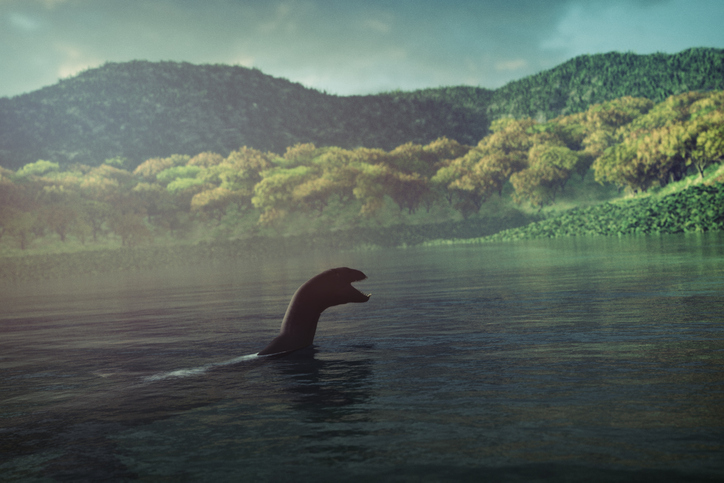
The most famous water monster, hands down, is Nessie. The first recorded Loch Ness Monster sighting was in 565 C.E. by the Irish missionary Saint Columbia, who stopped the creature from attacking a monk. The first "modern" sighting was April 14, 1933, when a couple driving around the loch saw a huge, long-necked beast crossing the road. Then there's the photograph that cemented Nessie's image in the world's imagination—the Surgeon's Photo. In 1934, gynecologist Robert Kenneth Wilson from London took a photograph of what looked like a plesiosaur.
A plesiosaur, an aquatic dinosaur that most likely went extinct during the Cretaceous–Paleogene extinction event about 66 million years ago.
Sure, plesiosaurs generally swam in warm saltwater, but they also swam in cold freshwater (such as the loch). According to the fossil record, these dudes could chunky dunk anywhere.
Sadly, in 1994, we discovered the Surgeon's Photo was a hoax. But the iconic image stuck. To the world, Nessie (if it exists) is a plesiosaur.
And so are a whole lot of water monsters worldwide.
The Hawkesbury River Monster in New South Wales, Australia, is reportedly eighty feet long, and, if Aboriginal petroglyphs are right—you guessed it—the monster looks like a plesiosaur.
The Great Prespa Lake Monster. Great Prespa Lake touches parts of North Macedonia, Greece, and Albania. Although this monster doesn't have the long history of Nessie, or the Hawkesbury River Monster, it possesses the same shape. Videos taken in 2017 and 2018 show what looks like the monster from the Surgeon's Photo swimming through the water.
Across the Atlantic is Argentina’s glacial lake Nahuel Huapi—home of Nahuelito. Nahuelito appears to be a plesiosaur. Although stories of the Nahuelito go back to the Tehuelche peoples of ancient Patagonia, they described it as a gigantic stingray.
When the Portuguese arrived in Argentina in the 16th Century, they reported seeing a monster in the lake. By the 1900s, the Nahuelito legend had acquired its current description, that of an extinct marine reptile.
Want more sushi?
In the US, there's the Nessie-Like Champ, Bessie, and Tahoe Tessie; Ogopogo in Canada; Sweden's Storsjöodjuret; and Morag of Scotland.
There are so many more, and why not? Do we really know what's in our deepest lakes, let alone the oceans? How much of our oceans have humans explored? About five percent.
No, we don't have a clue what lurks in the depths.
Tiny Terrors
Just as ancient legends of Bigfoot-like creatures exist nearly everywhere on the planet (except Antarctica—that we know of), spoken of as if they were real beings (for a reason), stories of little people are just as widespread.
Let's start with an East Coast favorite.
Pukwudgies. These little people of New England swamps and forests stand two-to-three feet tall, and have large ears, noses, and hands. While they can become invisible, or shapeshift to avoid the big people, they don't tolerate humans who don't treat nature—or the Pukwudgies themselves—with respect. They may attack rude big people with fire, or poison arrows. They can be kind, such as helping a person lost in the forest, or they can be mischievous, by using calls and lights to lead travelers into dangerous water or off cliffs.
They also steal babies. The Algonquian and Wampanoag peoples have stories of these little people stretching back thousands of years.
El Duende of the Yucatan. El Duende stand two-to-three feet tall, has large ears, noses, and hands. While they can become invisible, or shapeshift to avoid the big people, they don't tolerate humans who don't treat nature—or El Duende themselves—with respect. Then… Wait. That sounds familiar. I guess it’s because the description of El Duende is familiar.
Let's try Elves. Elves of the British Isles stand two-to-three feet tall, have large ears, noses, and hands. While they can become invisible, or shapeshi…
How about the Hiisi of Finland. Hiisi stand two-to-three feet tall, have large ears, noses, and hands. While they can become in…
No way. One more. Leprechauns. Leprechauns stand two-to-three feet tall, have large ears, noses, and hands. While they can…
Whoa.
The point is that for thousands of years unconnected peoples worldwide have all reported encountering—THE SAME ENTITY. There are cultural differences in them all—for example, the El Duende wears fancy green clothing and a jaunty hat—but the basic description is identical. Unfortunately, so is the baby-snatching.
The Alux of Mexico, the Huldufólk of Iceland, Brownies of the UK, Tomte of Scandinavia, Kobolds of Germany, Tokoloshe of South Africa, Walatha of Australia, Menehune of Hawaii, Red Caps, Kowi Anukasha, Callicantzaroi, Domovoi, and various other Goblins, Gnomes, Sprites, and Pixies. They're all the same.
How could this worldwide, vertically-challenged copy-and-paste be possible unless, unless… unless these guys are real?
Which brings us to the Ebu Gogo.
On the Island of Flores in Indonesia, there's an age-old story of the Ebu Gogo, two-to-three foot tall humanlike beings with large ears, noses, and hands. Although they don't shapeshift, or become invisible, like all little people legends, they were known for stealing babies. By the 18th Century, Flores's inhabitants gave the Ebu Gogo the gift of palm fiber to make clothing, and, once the little people shuffled off to their cave to put on pants, the locals built a fire at the cave mouth, killing everyone inside.
Genocide. What a cute story.
Western science did as Western science always does: it considered the stories of the Ebu Gogo to be myth. However, in 2003, researchers discovered a cave on Flores filled with the bones of a race of fully-grown humans that were a little more than three feet tall. This was branded as an entirely new branch of human—Homo floresiensis, but since scientists are the best kind of nerd, they nicknamed them Hobbits.
Yes, the little people were real.
By now, you've forgotten all about the cabbage palms in Ireland. That's a shame, really. The palms show us life can appear and thrive anywhere. Palms, elves, Sasquatch, or blood-sucking rug monsters.
Keep your eyes open, folks.

About Jason Offutt
Related Products


is subject to certain Terms and Conditions